The first type of shading I'll explain is the most common throughout artists. The Back and Forth Stroke consists of moving the pencil back and forth quickly on the paper to create what looks like numerous lines on the paper.

The picture on the left shows the Back and Forth Stroke. You can tell that from the lead, the pencil was being moved back and forth quickly to show a small fade all together. To show a darker shade with this technique I suggest to either keep the lines closer together or to press harder on the pencil. If you keep the lines closer together, it will just give the illusion of more lines being created, so a darker shade is shown. When you press your pencil harder, more lead is given on the paper so that could be an alternative as well.
The second form of shading is called the Hatching Technique. It consists of small lines being created close together to create a fill of color from far away. The more dots you add closer together causes a darker shade in this technique. Cross-Hatching is somewhat similar to Hatching except there is one more aspect to add. Cross-Hatching contains lines going one way and another set of lines going the other way.
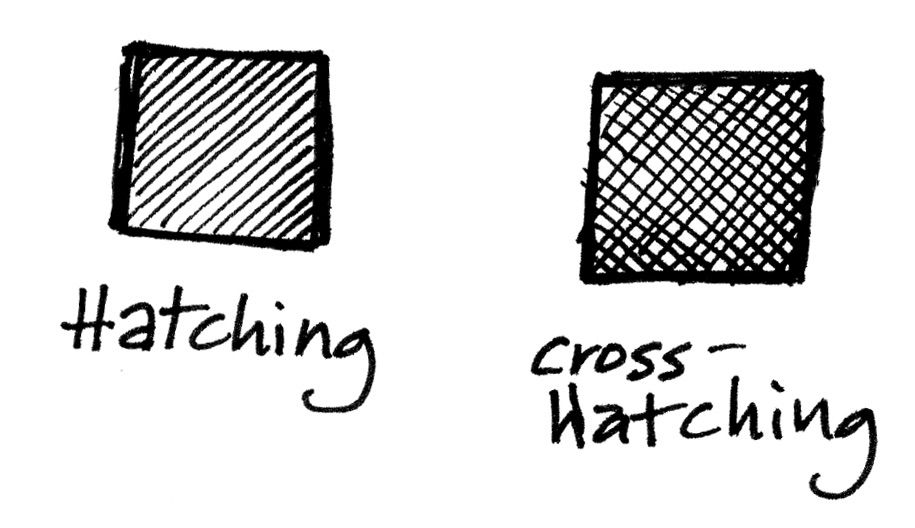
Cross-Hatching looks much darker than Hatching and more layers can be added to create the shade darker. The only way to make Hatching darker is to draw more lines and compress them.
Stipping is similar to the Hatching Techniques except instead of small lines, small dots or dashes are created instead.

If you notice closely to the photo above, the shading of the pedals have really small dots. This would be an example of Stipping. Unlike this picture, stipping is normally used for adding detail for smaller features such as eyes or facial hair. It's also very useful to blend them all together to fade it all together. To create the shade darker, you just simply add more dots in the picture.
Lastly, I will explain Scumbling. It's quite easy to do actually. You just move the pencil in a circular motion in the same general area to create a shade. It helps to keep the shade impact and is easy to blend by smudging them together.

Above shows Scumbling except the one on the right, the circles are more closer together to show a darker shade. On the left, the circles are found farther apart which results in a lighter shade than the one on the right.
These are a few of the types of shading that you can use for your drawings. I'll even try to use these too! It might even help me than the other types of shading I tried in the past.

That title tho
ReplyDelete