Saturday, December 31, 2016

And We're Blendingggggg

   One of the hardest and least favorite part about painting would have to be Blending. The most common reason is because it never comes out the way the artist wants it. It also varies between what the artist is using such as paint or pencil.
Blending and Scumbling - Acrylic Paint Lesson
Female Nose
              
   Above shows how blending appears in both drawing and paint. It's just using different shades of color being combined together smoothly to show a nice shade. It's commonly used in realistic drawings or landscapes to show how realistic the artist wants the painting to be.
  Blending was very difficult to accomplish for me, To this day, I still can not make a nice blend on any of my drawings. I've realized that the reason I couldn't create a nice blend was because I've been doing it wrong. I've always used my fingers to blend graphite onto the paper. It wasn't until I read a website about blending that using your fingers to blend the graphite on a paper is the worst way to do it. The reason for this is because fingers have natural oils and trying to blend graphite onto the paper will just smudge the graphite onto the fingers rather than the paper. I should also add that every time I used my fingers to blend the lead, it would never blend correctly. The graphite always just stuck to my finger and damage the paper every time I struggled to rub the graphite back onto the paper. It wasn't until I tried erasing to start over, that the graphite was rubbed in the paper and it would not come off. I ruined the drawing and I couldn't do anything about it anymore. What I'm trying to say is that, don't ruin your drawing by blending incorrectly.
  The best tools to blend on a drawing are Blending Stumps and Tortillions. They are sticks of rolled up felt paper with pointed ends. The difference between them are not that significant. A tortillion is harder than a blending stump, so it requires more effort to blend graphite onto a paper. It should also be used at an angle or else the tip would collapse and it would have to be fixed back into place with a toothpick or any other small pointed object.
   
Arya Stark (Game of Thrones) Speed Drawing
   To blend with a blending stump requires to use the tool and push the graphite back and forth until the shades are combined
  There are alternative tools to blend. For example, tissue can be used. It's commonly used only for lighter shades or else the graphite will transfer all onto the tissue just like a finger would. A Q-tip could also be used to cover large areas unless the tip is twirled to a fine point. 
   Blending for paint is a completely different story. I watched a really great video about blending acrylic paint onto a canvas. he explained what it was and how he does it. The way blending woks for acrylics is a lot of layering of the paint. Acrylics dry quickly, so using a damp brush would work perfectly to applying the paint, Applying the 1st layer would turn out transparent so it's recommended to put a second layer to make sure the paint can look opaque. The paint left on the brush can also be used for scumbling which is moving the brush in circles constantly to create a dry effect. It's commonly used for clouds and other types of fluffy strokes. Blending can also occur with scumbling by creating the effect on wet paint. 
  While the paint is still wet, apply the paintbrush (with remaining paint still from previous color) with white paint. It's okay to clean the brush off from the previous color, but it's recommended to leave the previous color on to create a lighter shade using the same color. You want to make sure that when blending the colors together, the paint is still wet. If not, then wet the paintbrush slightly and continue.
   Blending can occur by just softening the edges of the paint. But the description above can help with blending two different colors together, 
   Painting might be a bit harder because it's unable to go back but it's still fun to try it out and practice. Practice is key when becoming better. Not only have I learned more about blending with both drawings and paintings, I hope you have too. I can't wait to try it out on my next piece!

Friday, December 30, 2016

This Coloring Book Belongs to an Adult

   Most of the coloring you have done in your life was likely during your childhood. If not, then.......I'm sorry. Even if you haven't, you probably have in some point of your life and realized how fun coloring can be! Many people have different objectives when coloring but most people go for how nicely they can color the page without having any of the color go outside the lines. No matter how you color it, we can all agree that coloring is fun and even though we don't do it as much anymore, we believe that coloring should only occur when we are children. Well, not exactly.
   The coloring books you had as a child were simple (or at least I hope they were), where they had either princesses, flowers, or superheros. No matter what they had, it was still fun to color. It really helps to go back to those "childhood days" where people can be themselves because they can color the way they want to. It gives people the freedom to be creative in their own way.
  This may be one of the reasons a lot of therapists/psychologists consider coloring to better their patients. For example, Ben Michaelis, a clinical psychologist, recommended coloring because it relaxes the amygdala which is the fear center of the brain which allows the brain to rest. Carl Jung another famed psychologist suggested coloring for his patients as well because it reduces stress and cause for them to become calmer. He suggests for his patients to color mandalas which are geometric figures that are often representations of the universe in Hindu or Buddhism.
   The image above shows an example of a mandala. You can tell that they look complex and very detailed. This may be one of the reasons they take awhile to completely color.
   When I explained about how drawing can help with multitasking with the brain and the fingers in my later post, multitasking can also apply in coloring. Psychologist Gloria Martinez Ayala says that the "action involves both logic, by which we color forms, and creativity, when mixing and matching colors." In other words, coloring can help with both logic and creativity. When you color a dog you won't obviously color the dog purple, because logically a dog will not have purple fur (unless you freely want to color a dog purple, no one is stopping you). Logically people would color the dog either brown, black, white, or any color that a dogs fur normally would be. This helps with the brain to logically choose the right choice, while also giving it creativity of mixing colors together to see how the page will come out. In a coloring page filled with farm animals in a meadow with trees and flowers, people can color it with any colors they want. This builds their creativity of choosing any colors they would want and see the outcome of their choices.
   Peoples focus can also become better with coloring. It secretly helps with the brain by focusing on constantly trying to make sure that non of the color passes through the lines. This may also be the reason that children's coloring books are much simpler than adult coloring books in which adult coloring books include mandalas and detailed pages.
   So even if it's just for fun or just to get your mind off things. Coloring can be both for children and adults. Adults have many benefits to it and children do too! It's not fair for children to only have the advantage. 

Sunday, December 18, 2016

Shady Shadings

   There is one very important aspect to drawing that gives it life. Without it, all drawings will be dull and stuck in 2D. So without it, people won't see drawings the way they do today. Shading can be either really easy or really difficult. For me personally, it is very difficult because I never really tried different types of shading other than just placing many lines on the paper and smudging it with my finger. Honestly, it works except my fingers get really dirty and the paper starts to become damaged by the many times of rubbing lead into it. So, I have to be very limited on shading in my drawings. Little to my knowledge, there are different types of shading and in some they can be blended to create a shade. That's very useful because then I don't damage the paper as much as I already do while drawing.
   The first type of shading I'll explain is the most common throughout artists. The Back and Forth Stroke consists of moving the pencil back and forth quickly on the paper to create what looks like numerous lines on the paper.
 
   The picture on the left shows the Back and Forth Stroke. You can tell that from the lead, the pencil was being moved back and forth quickly to show a small fade all together. To show a darker shade with this technique I suggest to either keep the lines closer together or to press harder on the pencil. If you keep the lines closer together, it will just give the illusion of more lines being created, so a darker shade is shown. When you press your pencil harder, more lead is given on the paper so that could be an alternative as well.
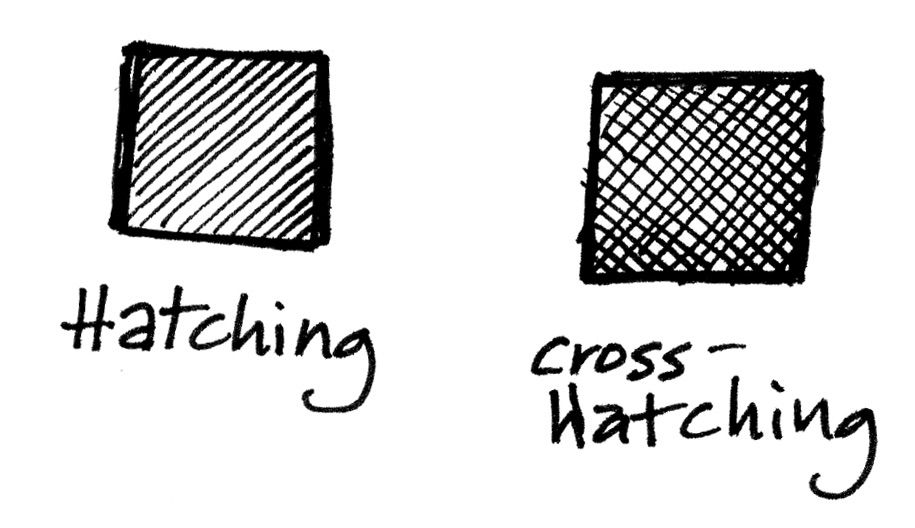
   The second form of shading is called the Hatching Technique. It consists of small lines being created close together to create a fill of color from far away. The more dots you add closer together causes a darker shade in this technique. Cross-Hatching is somewhat similar to Hatching except there is one more aspect to add. Cross-Hatching contains lines going one way and another set of lines going the other way. 
   Cross-Hatching looks much darker than Hatching and more layers can be added to create the shade darker. The only way to make Hatching darker is to draw more lines and compress them.
   Stipping is similar to the Hatching Techniques except instead of small lines, small dots or dashes are created instead.
   If you notice closely to the photo above, the shading of the pedals have really small dots. This would be an example of Stipping. Unlike this picture, stipping is normally used for adding detail for smaller features such as eyes or facial hair. It's also very useful to blend them all together to fade it all together. To create the shade darker, you just simply add more dots in the picture.
   Lastly, I will explain Scumbling. It's quite easy to do actually. You just move the pencil in a circular motion in the same general area to create a shade. It helps to keep the shade impact and is easy to blend by smudging them together.
Above shows Scumbling except the one on the right, the circles are more closer together to show a darker shade. On the left, the circles are found farther apart which results in a lighter shade than the one on the right.
   These are a few of the types of shading that you can use for your drawings. I'll even try to use these too! It might even help me than the other types of shading I tried in the past.

Saturday, December 10, 2016

Variety of brushes for a variety of colors

   When an artists comes to the conclusion that they want to start a painting, they need to get their supplies to create the piece. They need the paint (and everything else that has to "activate" their choice of paint), their canvas, an idea of what they are going to be painting, and of course, their brushes. This could be crucial to creating a piece because the choice of brushes really affect how easy or difficult it can be to create the painting. For example a brush with a thin tip will be much more tedious to color a whole canvas with that small tip, rather than a brush that has more bristles. It's not impossible to use the thin ended brush, just a lot more work.
   Let's start with the basics.

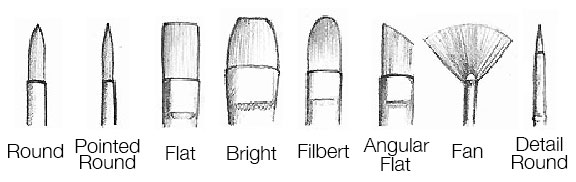
   These are not all the types of brushes out there, but it's only here to give you a good idea of what I am talking about. In the example I used before, a Pointed Round brush would be much harder to color a whole canvas with one color rather than a Bright or Flat brush in which there are much more bristles to cover the canvas, thus having more paint being splattered on.
   Each brush has it's purpose. The Round is good to use when creating thin marks such as filling in spaces or just adding detail to the painting. The Point Round is also very well used for adding detail and retouching your piece but the strokes are much more thin. The Flat and Bright brushes can both be used to create heavy strokes except the Bright brush would probably be used better up close rather than just applying the paint all loosely like the Flat Brush. The Filbert can be a combination of both a Round brush and a Flat brush because of it's thin point and because of how flat the bristles are. The fan brush however can be able to create unique strokes. It can be able to apply hair-like strokes and textures on the picture for leaves on a tree, or on a cloud in the sky. The angular flat can be able to create curved strokes, and is able to fill in spaces like all the other types of flat brushes. Then lastly, the detailed brush does what is named. It gives details to the paintings for it's small amount of bristles it has at the end of the brush.
   These are just a few out of many types of brushes. These are just here to start you off when creating your piece for the first time, or your second, or to refresh your memory in what the most common types of brushes do. Make sure to get the ones you need to create your piece, and you'll be just fine :)

Why Draw?

  When I draw, I feel like all time stops. It feels like the only existent things in the world is me, the paper, and the pencil being moved swiftly with my fingers. I am left alone with my thoughts being transferred onto a piece of paper in a form that looks like the piece was delicately created with each detail given much thought. I am so calm that it feels like all my worries go away temporarily for me to just complete the drawing. And when I finally finish, I am proud of it no matter how it looks. I feel so relieved and calm because I was able to create something out of my own image and paste it on a piece of paper. This is just an example of what drawing feels like to me. For others, it might feel stressful trying to create the piece perfectly but if you take it in an optimistic perspective, it can feel a lot better.
   Based on what I hear, many people say drawing can be beneficial because it can be a form of meditation or stress reliever. Some people even say it's a way to get off the brain draining computers and phones we use all day and focus on the world around us. In reality, it can have many more benefits than you might think.
   First, you have to realize that drawing takes a lot of hand-eye coordination (or using your hands and eyes together for a certain activity). If you notice an artist drawing or painting, whichever it may be, you notice that their eyes are shifting constantly. I noticed this when my ninth-grade Ecology teacher was explaining to us how to draw. She all made us draw something and as I looked around, I see the people who were "decent" move their eyes constantly to their paper and the image they were trying to recreate. They check every detail that goes with it to make sure it comes out right. Not only are they using their eyes but they are also using their hands, and brain to create the image. Using them all at the same time can cause benefits to use them much quicker. So the more you draw, the easily it is to use them smoothly and faster together.
   In the modern world, you realize that everyone has a cellphone. Teenagers, adults, or even little kids might have some sort of technology that causes them not to pay attention to the world around them. It also takes a lot of our free time away; constantly scrolling and scrolling and scrolling until it doesn't become fun anymore. Drawing can help to draw attention away from our cellphones or computers. It requires a lot of focus, so we can focus on our paintings or drawings rather than our cellphones and computers! And since you brain, eyes, and hands are all being used to create something, that means you are being productive in creating pieces that you enjoy doing. Also that you will never be bored because paintings/drawings take forever to finish.
   Believe it or not but drawing or any form of creating art can also help in decision making. If you have drawn before, you realize that if the drawing is not going the way you wanted it to go, you would have to make some decisions that might ruin the piece all together. After awhile, you also start to realize what are good decisions that you took and what are not. This benefits in a way to increase the ability of problem-solving.
   I think most of us can say that we've doodled before. In fifth grade, I use to doodle all over my notes, from little flowers at the bottom of the page, to large patterns taking over half of my paper. What I didn't realize was that it was actually helping me in a way of boosting my creativity. The more you doodle/draw your mind starts to realize the same shapes and patterns, which causes for a variety things you can create. So just a few couple of minutes a day of drawing, can have dramatic effects on your creativity.
   Just try to doodle here and then to see what happens. You might even like it so much that you'll start to practice more; and the more you practice, the better you'll become. It's the small things that count to become a better artist. Becoming an artist helps in so many ways that are so beneficial. You start to realize what is happening in the world around you and become calmer and less stressed. So just try it! See what benefits you :)